
Bilingual Wedding Weekend Itinerary Template
A useful bilingual wedding itinerary does more than list times and locations. It assigns an owner to each transition, shows which guest instructions need English or Spanish wording, and separates confirmed details from questions for the parish, civil registry office, consulate, venue, vendors, or family.
Use the template below as an internal planning document first. Create a shorter guest-facing version after the schedule, language plan, and local confirmations are settled. The sample sequence is a planning option, not a universal wedding or ceremony order.
Bilingual Wedding Weekend Itinerary Template
Weekend Overview
Couple: [Names]
Wedding weekend dates: [Date range]
Primary ceremony location: [Location]
Reception location: [Location]
Civil registry appointment, if applicable: [Date, time, location]
Main guest languages: [English, Spanish, both, or other]
Day-of schedule owner: [Name and phone number]
Family communication owner: [Name]
Language-support owner: [Name]
Transportation owner: [Name]
Venue contact: [Name and phone number]
| Time | Event | Location | Primary owner | Guest-facing language | Status |
|---|---|---|---|---|---|
| [Time] | Guest arrival | [Location] | [Name] | English / Spanish | Confirmed |
| [Time] | Ceremony seating | [Location] | [Name] | English / Spanish | Confirm |
| [Time] | Ceremony | [Location] | [Name] | [Language plan] | Ask the parish |
| [Time] | Family photographs | [Location] | [Name] | English / Spanish | Confirm |
| [Time] | Transportation to reception | [Pickup point] | [Name] | English / Spanish | Confirm with provider |
| [Time] | Welcome period | [Location] | [Name] | [Language plan] | Confirm with venue |
| [Time] | Dinner and reception program | [Location] | [Name] | [Language plan] | Confirm with venue |
| [Time] | Closing and departures | [Location] | [Name] | English / Spanish | Confirm |
Keep one internal version with vendor access, setup windows, contact numbers, family assignments, and delay notes. The guest-facing version should show only the locations, times, movement instructions, language support, and day-of contact information.
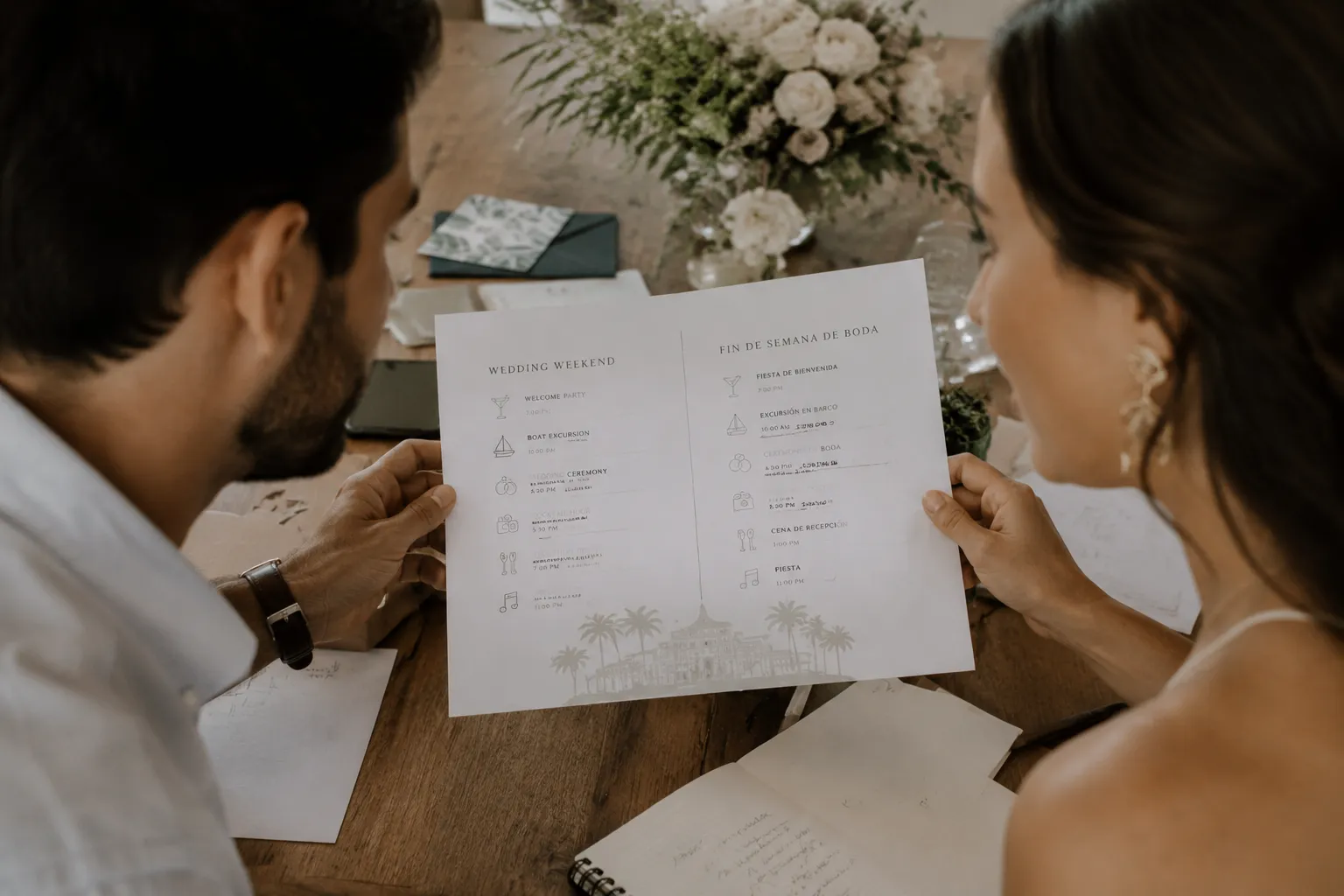
How to Build a Bilingual Wedding Itinerary
Begin with fixed points such as the ceremony, venue access, transportation departures, meal service, rehearsal, family gathering, or civil registry appointment. Work backward from each point and add time for guest movement, seating, photographs, interpretation, vendor setup, and room changes.
- List the weekend dates, locations, guest groups, and likely language needs.
- Mark the ceremony, reception, rehearsal, transportation, and registry-office points.
- Ask the venue about access, layout, parking, catering, equipment, and vendor restrictions.
- Assign a named owner and backup to every major transition.
- Decide which readings, prayers, announcements, speeches, and instructions need interpretation.
- Prepare aligned English and Spanish guest information using natural wording in each language.
- Rehearse the ceremony sequence and handoffs between family members, attendants, vendors, and interpreters.
- Reconfirm the final schedule with the relevant parish, registry office, venue, vendors, families, and transportation provider.
Planning research supports this kind of fixed-point, role-based workflow, but it does not establish a universal Mexican Catholic ceremony order, bilingual terminology, parish procedure, civil-registration process, or guest expectation. Treat those as local or family decisions.
Ceremony Timing in the Wedding Itinerary
Place the ceremony at the center of the schedule, then build surrounding events around its actual sequence. A parish or officiating institution may set expectations for rehearsal, readings, music, photography, arrival times, or movement. Ask the parish before printing the program.
| Ceremony point | Planned time | Person responsible | Language plan | Confirmation |
|---|---|---|---|---|
| Couple and family arrival | [Time] | [Name] | Internal cue | Parish or venue |
| Guest seating begins | [Time] | [Name] | English / Spanish | Venue |
| Processional begins | [Time] | [Name] | Internal cue | Parish |
| Readings or shared responses | [Time] | [Name] | [Language arrangement] | Parish |
| Interpretation, if planned | [Time] | [Name] | English to Spanish or Spanish to English | Parish |
| Ceremony conclusion | [Time] | [Name] | Guest announcement | Parish |
| Family congratulations | [Time] | [Name] | English / Spanish | Couple and family |
| Formal photographs | [Time] | [Name] | English / Spanish | Photographer |
Some couples use parallel interpretation, while others interpret selected moments or combine both languages within a section. Decide which approach suits the ceremony, parish expectations, and guests' needs. Do not assume that every spoken element should be repeated word for word.
Ask:
- Which parts may be delivered in each language?
- Is interpretation permitted during readings, vows, prayers, or announcements?
- Who should review the bilingual wording?
- When should the couple, family members, sponsors, and attendants arrive?
- Is a rehearsal available, expected, or optional?
- Where may photographers and guests stand?
- Are there restrictions on music, decorations, ceremonial objects, or movement?
For any family custom or ceremonial object, record what the couple wants to include, who will provide or carry it, and what the parish needs to confirm. That keeps a family preference separate from an institution's procedure.
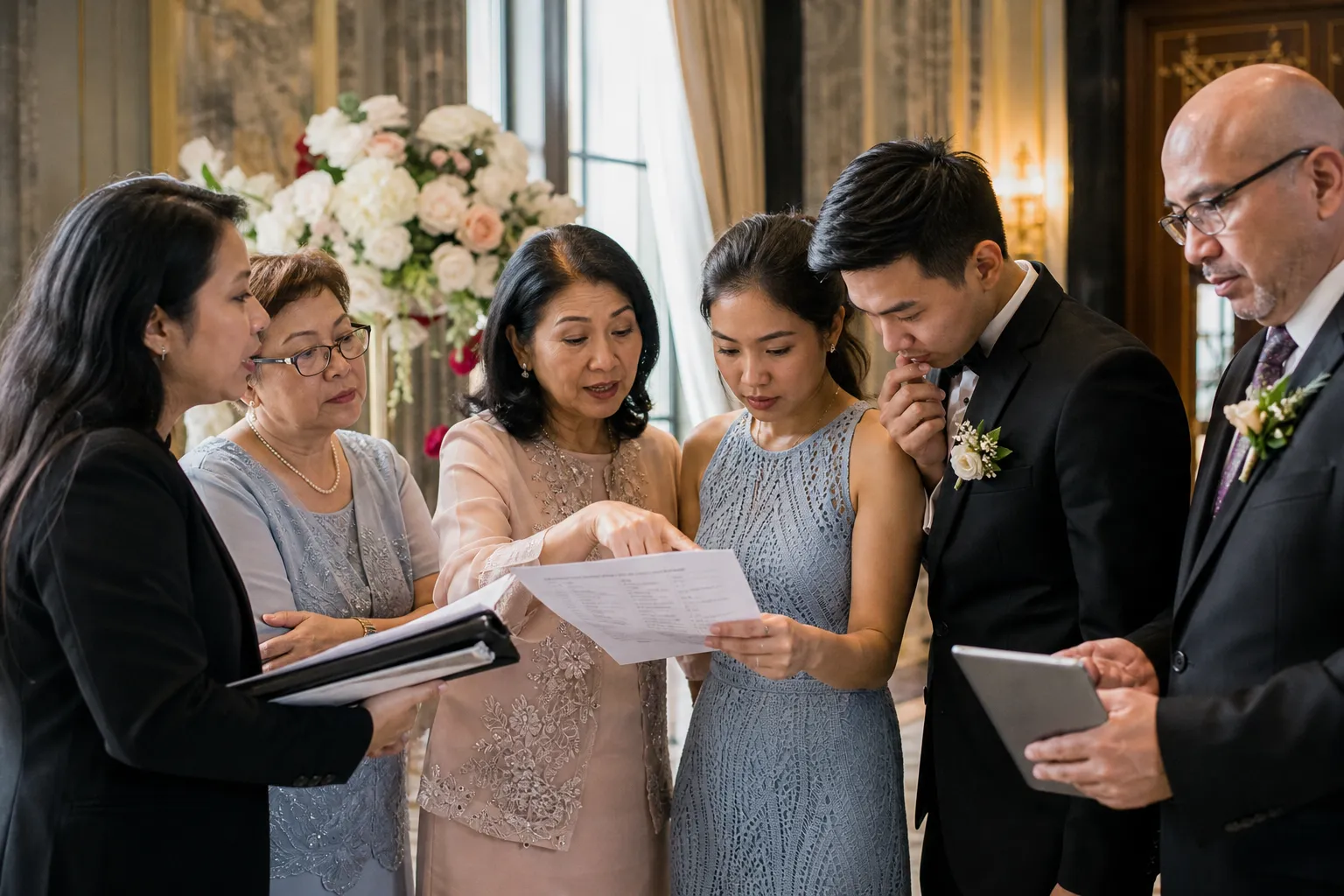
Family Roles and Wedding Itinerary Assignments
Language support and family communication are work assignments, not informal tasks left to whoever notices a problem. A madrina, padrino, parent, sibling, attendant, planner, or friend may hold a role depending on the family's preferences and the event's size.
| Role | Responsibilities |
|---|---|
| Schedule lead | Maintains the master itinerary and handles timing decisions. |
| Family liaison | Sends updates to both families and gathers questions. |
| Language-support lead | Coordinates interpretation and checks guest-facing wording. |
| Ceremony liaison | Confirms arrival, seating, rehearsal, and ceremony details. |
| Venue liaison | Handles access, layout, setup, catering, equipment, and venue questions. |
| Transportation lead | Tracks pickup points, departure times, addresses, and delays. |
| Guest welcome lead | Greets guests and explains the first transition. |
| Reception program lead | Coordinates speeches, meal service, announcements, and special moments. |
| Vendor contact | Shares the final schedule and handles day-of questions. |
| Closeout lead | Tracks personal items, gifts, rentals, payments, and departures. |
Give every role one primary owner and one backup. The backup should have the current itinerary, venue contact, transportation details, and wording for key announcements.
Bilingual Guest Communication
Create parallel English and Spanish information when both language groups need the same instruction. Keep the meaning aligned, but let each version sound natural rather than translating every phrase mechanically.
Prioritize information that affects movement or timing:
- Ceremony and reception locations
- Arrival and seating times
- Transportation pickup points
- Parking instructions
- Dress expectations
- Meal timing
- Family photographs
- Reception transitions
- Accessibility or mobility information
- Day-of contact information
| English | Spanish version prepared by |
|---|---|
| Ceremony seating begins at [time]. | [Name] |
| Transportation leaves from [location] at [time]. | [Name] |
| Please remain at the venue for family photographs. | [Name] |
| Dinner service begins after the welcome remarks. | [Name] |
| Questions about transportation can be directed to [name]. | [Name] |
State whether an announcement will be repeated, summarized, displayed in the program, or handled by a designated interpreter. Avoid assigning interpretation to a family member without confirming availability and preparation time.
Venue Logistics for a Wedding Weekend
The venue may shape the order and length of the day. Add these details to the internal itinerary rather than leaving them only in vendor messages:
- Entry times for the couple, family, vendors, and rental teams
- Decoration and equipment setup windows
- Guest waiting areas before the ceremony
- Room resets between ceremony and reception
- Routes between rooms or locations
- Transportation loading and unloading points
- Parking information for guests
- Catering service times
- Included sound, lighting, tables, chairs, and media equipment
- Outside-vendor, decoration, music, photography, and cleanup restrictions
- The person who may approve a timing change on the wedding day
A shared schedule helps the venue, transportation provider, photographer, caterer, family liaisons, and language-support lead work from the same information.
Reception Flow in a Bilingual Wedding Itinerary
Show the order of major moments and the language plan for each one. A possible outline includes arrival, refreshments, introductions, speeches, dinner, dancing, dessert, closing remarks, and departures. The final order should reflect the couple's choices, venue service pattern, family expectations, and selected cultural elements.
| Reception moment | Planned time | Lead person | Language approach | Venue or vendor note |
|---|---|---|---|---|
| Guest arrival | [Time] | [Name] | Welcome in both languages | Confirm doors open |
| Welcome remarks | [Time] | [Name] | Parallel or summarized | Confirm microphone |
| Dinner service | [Time] | [Name] | Printed menu or announcement | Confirm service timing |
| Family speeches | [Time] | [Name] | Original language plus interpretation | Confirm speech length |
| Selected program moment | [Time] | [Name] | Announcement in both languages | Confirm music cue |
| Dessert or cake service | [Time] | [Name] | Announcement in both languages | Confirm kitchen timing |
| Closing and departures | [Time] | [Name] | Printed and spoken instructions | Confirm pickup window |
Build short transition spaces into the schedule. They give guests time to move, vendors time to reset a room, and the language-support lead time to communicate without forcing every activity to start immediately.
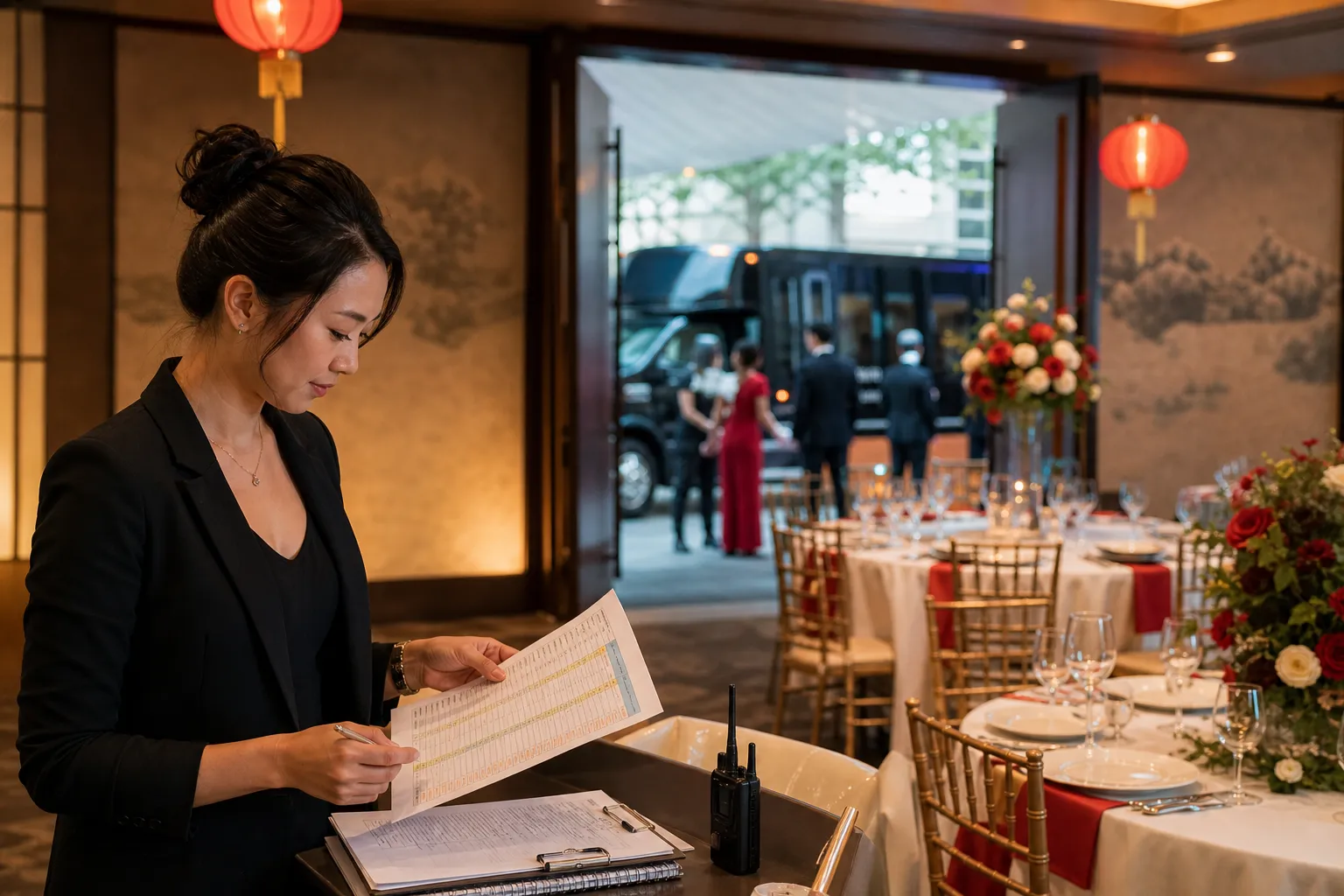
Civil Registry Timing and Local Confirmation
Some couples place civil registry activities on the same weekend as the ceremony. Others use a separate date. The sequence depends on the jurisdiction, appointment availability, document questions, residency circumstances, and the couple's situation.
| Question | Assigned owner | Confirm with |
|---|---|---|
| Is an appointment needed? | [Name] | Civil registry office |
| Which documents or translations should be prepared? | [Name] | Civil registry office or local authority |
| Are witnesses, interpreters, or other participants discussed by the office? | [Name] | Civil registry office |
| Can the appointment occur before or after the ceremony? | [Name] | Civil registry office |
| Are residence or consular questions involved? | [Name] | Registry office, consulate, or local authority |
| What happens if the appointment changes? | [Name] | Couple and schedule lead |
Keep civil registry planning as a separate track from the religious ceremony unless the relevant office and institution have confirmed the arrangement. An itinerary can organize questions and appointments; it cannot determine what a registry office or parish will accept.
Bilingual Wedding Schedule Example
This example is an illustrative planning model, not a cultural or institutional standard.
Friday
- 4:00 p.m. Family arrivals and informal welcome
- 6:00 p.m. Bilingual schedule review with immediate family
- 7:00 p.m. Rehearsal or ceremony walk-through, if arranged with the parish
- 8:30 p.m. Family dinner and final questions
Saturday
- 10:00 a.m. Couple and vendor preparations
- 1:30 p.m. Ceremony-party arrival
- 2:00 p.m. Guest seating begins
- 2:30 p.m. Ceremony begins, subject to parish confirmation
- 3:30 p.m. Congratulations and family photographs
- 4:30 p.m. Transportation or guest movement to reception
- 5:00 p.m. Reception welcome and refreshments
- 5:45 p.m. Bilingual welcome remarks
- 6:00 p.m. Dinner service
- 7:15 p.m. Speeches and selected family program moments
- 8:00 p.m. Dancing or other reception activities
- 9:00 p.m. Dessert or cake service
- 10:30 p.m. Closing remarks and departure instructions
Sunday or Separate Registry Date
- [Time] Civil registry appointment, if scheduled
- [Time] Document follow-up or family gathering
- [Time] Return transportation and personal-item check
The useful feature is the ownership and confirmation information. Each line should show who acts, what guests need to know, and whether an institution or vendor still needs to confirm the plan.
Final Confirmation Prompts
- Has the parish confirmed the ceremony sequence, arrival time, rehearsal, language arrangement, and photography boundaries?
- Has the civil registry office answered the appointment and document questions?
- Has the consulate or local authority been contacted when cross-border matters apply?
- Has the venue confirmed access, layout, setup, catering, equipment, parking, and cleanup?
- Has transportation received the correct addresses, pickup times, passenger count, and contact numbers?
- Does every major transition have a primary owner and backup?
- Are the English and Spanish guest instructions aligned?
- Which announcements require interpretation, and who will deliver them?
- Have family members agreed who will carry, prepare, explain, or present any selected ceremonial item?
- Have vendors received the same final schedule?
- Is there a short plan for delays, late arrivals, venue changes, or a missed transportation window?
- Have internal notes been removed from the guest-facing version?
A bilingual wedding itinerary works best when it separates the couple's choices, family expectations, venue constraints, and institution-dependent procedures. That distinction gives everyone a usable schedule while leaving parish, registry-office, consular, and local questions with the people responsible for confirming them.