
Bilingual Wedding Translation Style Sheet and Review Checklist
When a wedding uses English and Spanish, review the wording by purpose before editing the sentences. A bilingual wedding translation checklist should separate liturgical text, printed program wording, family communication, venue instructions, spoken interpreting, and civil paperwork.
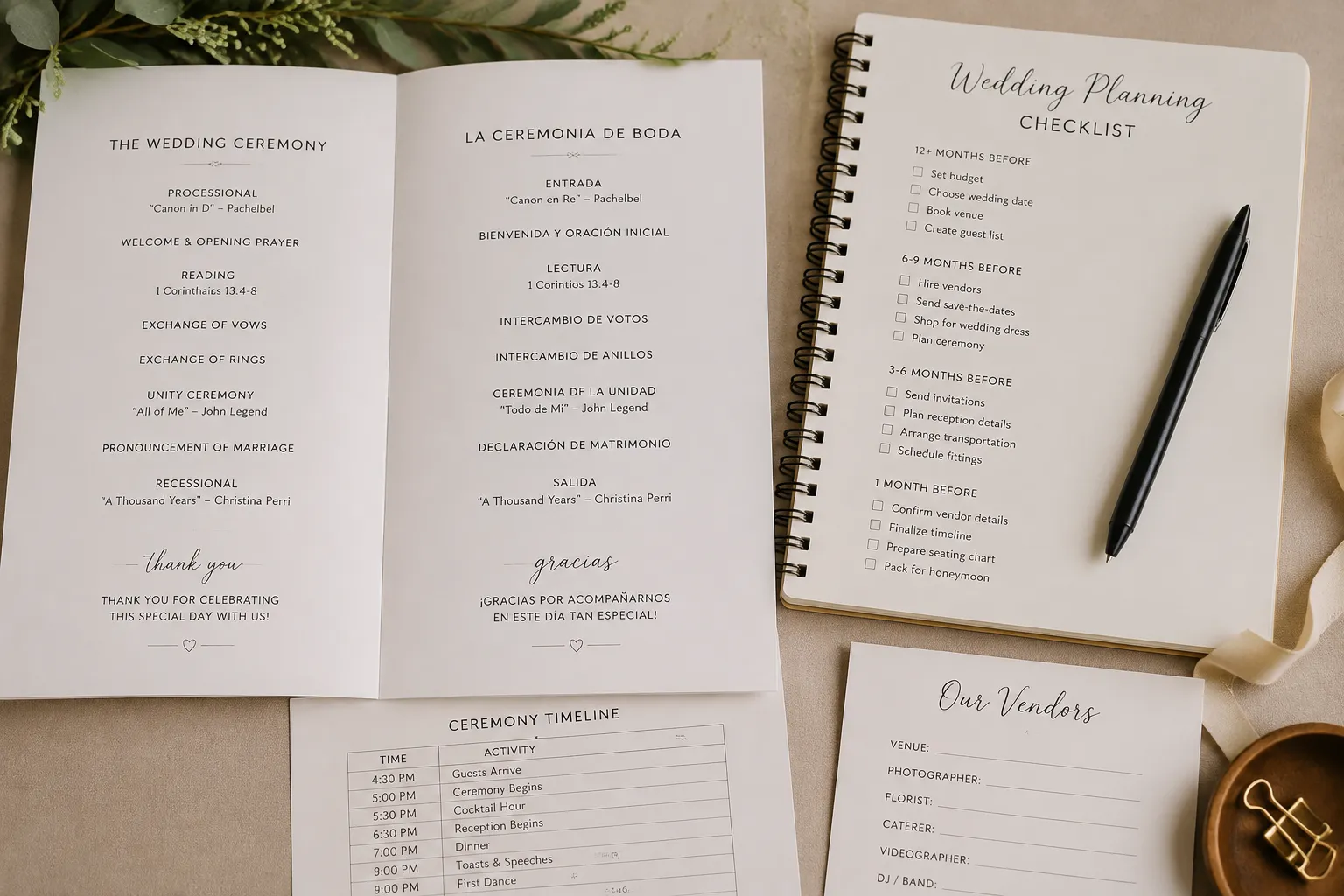
Then identify who prepares, reviews, and confirms each item. The translator handles the second-language draft. A language reviewer checks meaning, names, terminology, tone, and consistency. The person responsible for the setting, such as the couple, family, parish, venue, or civil registry office, confirms questions within that setting.
This prevents one informal translation from being treated as the wording for every part of the wedding.
Start With a Bilingual Wedding Style Sheet
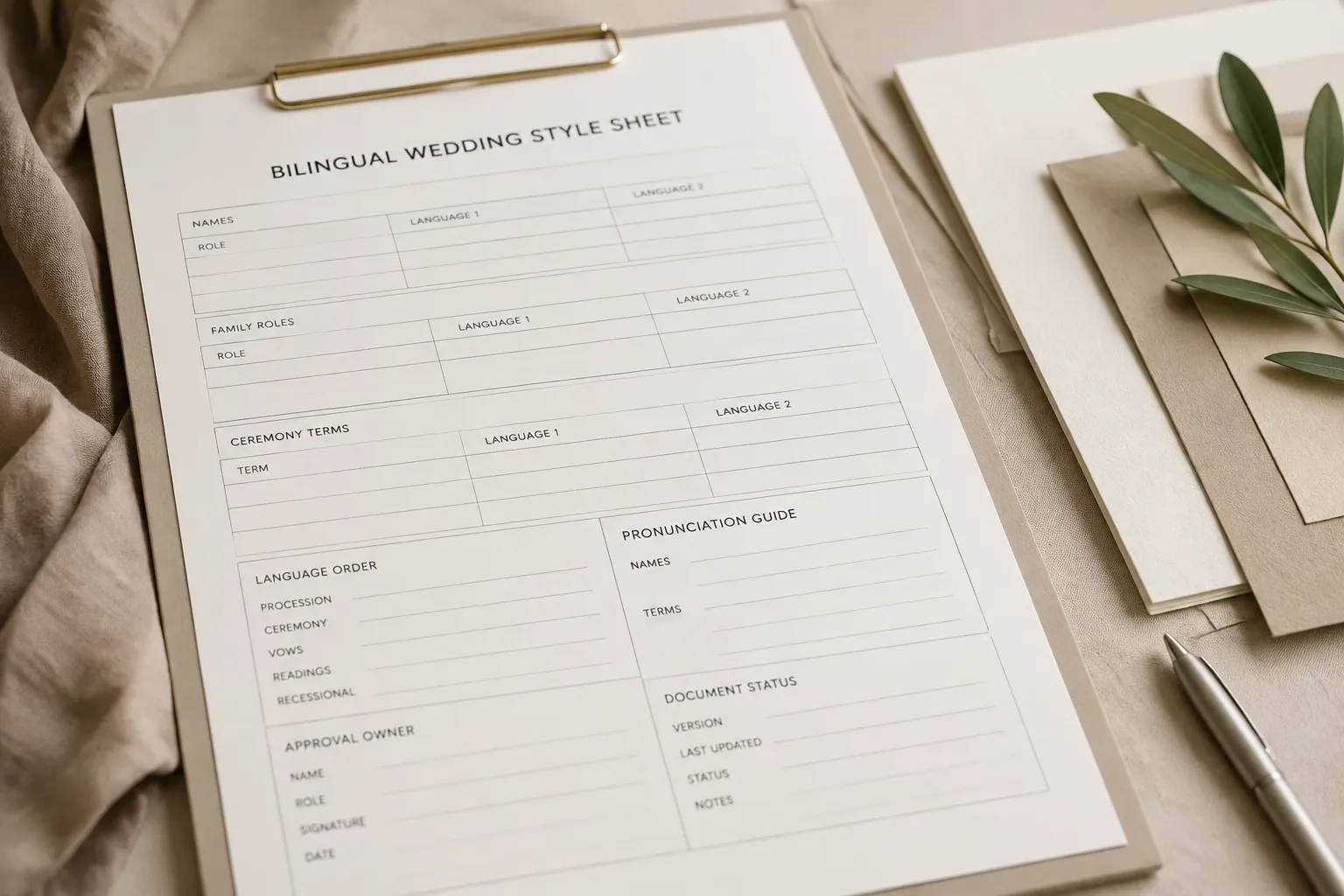
A style sheet records wording decisions before they are repeated across invitations, programs, messages, and rehearsal materials. Keep it short enough for relatives and vendors to use, but specific enough to settle recurring questions.
| Style-sheet item | What to record |
|---|---|
| Couple's names | Exact spelling, accents, capitalization, and preferred order |
| Family names and roles | Parents, sponsors, padrinos, madrinas, readers, witnesses, and other relevant roles |
| Ceremony terms | The wording used for each ceremony stage |
| Language order | Whether English or Spanish appears first in each document |
| Formality | Formal, conversational, devotional, or family-facing tone |
| Repeated terms | Preferred translations for recurring words and headings |
| Names and titles | How priests, readers, sponsors, parents, and witnesses are identified |
| Pronunciation notes | Names or terms that need advance review before being spoken |
| Approval owner | The person or institution responsible for the final decision |
| Document status | Draft, family-reviewed, parish-confirmed, venue-confirmed, or submitted |
Do not force one language order across every item. A ceremony program may use parallel English and Spanish text, while a family message may need a warmer, more direct register. The goal is consistent meaning and clear responsibility, not visual symmetry alone.
Label Each Phrase by Where It Will Appear
The same idea can require different wording when it is spoken, printed, submitted, or shared informally. Labeling the intended use keeps a natural guest explanation from being mistaken for ceremonial or administrative wording.
Liturgical text
This category includes prayers, readings, vows, responses, blessings, and other language used within the Catholic ceremony. Keep it separate from a translation prepared only to help guests understand the service.
Catholic reference material can help organize terms by ceremony stage, but it does not establish one bilingual script for every parish. Ask the parish which wording and sequence apply before printing or rehearsing ceremonial text. A conversational translation may sound fluent while changing the register or meaning of the rite.
Printed program text
A program can explain ceremony stages, readings, family roles, and guest instructions without reproducing the words spoken by the priest or congregation. Mark this copy as informational unless the parish has supplied or confirmed a particular formulation.
Family communication
Family messages often cover schedules, role assignments, dress expectations, rehearsal details, transport, and requests involving relatives. Prioritize clear wording and a respectful tone.
Decide whether the text is being translated for people to reread or interpreted during a conversation. Written translation needs stable wording. Spoken interpreting also requires attention to timing, turn-taking, pronunciation, and who can clarify an uncertain phrase.
Venue instructions
Venue wording may cover arrival, setup, music, photography, food service, seating, and vendor coordination. Keep these instructions separate from religious language, even when both appear in the same planning folder.
A family translation can help relatives understand the instructions, but the venue should confirm the operational version that people will follow.
Civil paperwork
Forms, identification documents, certificates, and registry correspondence need their own review path. Record the document's purpose, language, requesting office, translation status, and contact for questions.
Handling instructions can vary by state, country, registry office, and document type. Confirm the current process with the relevant civil registry office or local authority before relying on a translated document.
Review the Ceremony in Stages
Reviewing the ceremony stage by stage makes missing or duplicated wording easier to find. Use the local ceremony outline as the working reference, then match each stage to the bilingual materials.
For every stage, check:
- The stage heading in both languages
- The people involved
- The wording that will be spoken
- The wording that will be printed
- Any response expected from guests or the congregation
- The reading, prayer, vow, blessing, or announcement connected with the stage
- Whether the parish has supplied or confirmed the text
- Whether the program explanation matches what will actually happen
Stage: Exchange of consent
Printed wording: Bilingual explanation for guests
Spoken wording: Parish-confirmed ceremony text
Reviewer: Person checking terminology and names
Decision owner: Parish contact for ceremonial wording
This format keeps an explanatory program sentence from being confused with the words used during the ceremony.
Example: A Bilingual Catholic Wedding Program
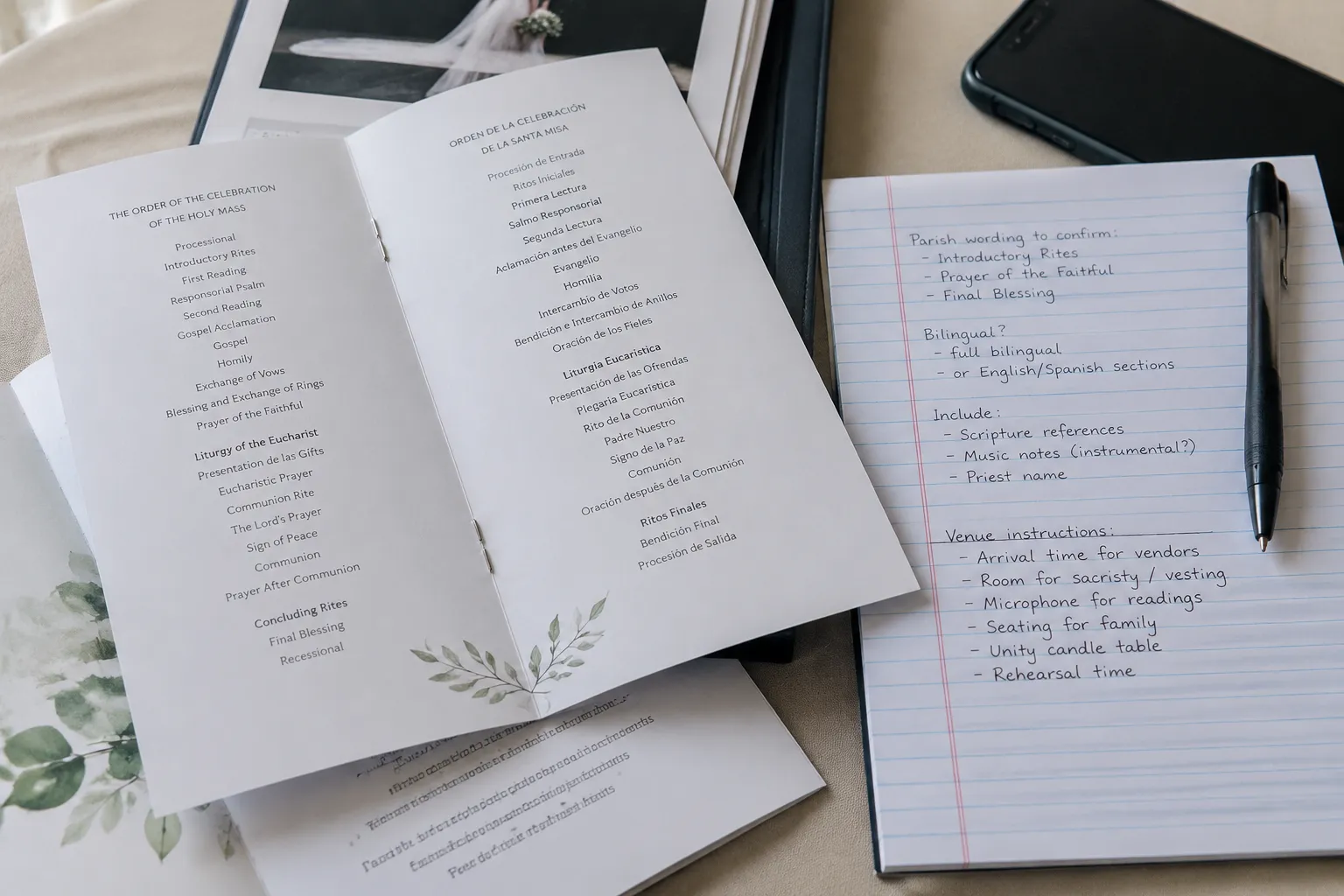
Suppose one family member drafts English and Spanish descriptions of the ceremony stages. Another person checks the couple's names, parents' names, sponsor roles, readings, and page order.
Before printing, the couple asks the parish whether the description of the marriage consent matches the wording and sequence used in that parish. They also ask the venue to confirm bilingual arrival and photography instructions.
Each question then has a clear destination:
- The family checks whether the wording is understandable and respectful.
- The couple checks names, roles, and preferred language balance.
- The parish answers questions about ceremonial wording and sequence.
- The venue confirms operational instructions.
- The civil registry office or relevant authority answers document-handling questions.
This is an example of a review workflow, not a universal process. It shows why one person should not be expected to confirm every category.
Assign Translation and Review Responsibilities
Write a named person beside every section. A label such as “family review” is incomplete unless the document states who makes the final decision.
- Prepared by: The person who drafted or translated the wording
- Language reviewer: The person checking grammar, register, and meaning
- Family reviewer: The person checking names, relationships, and family expectations
- Parish contact: The person handling ceremony-related questions
- Venue contact: The person confirming event instructions
- Civil-office contact: The person answering document-specific questions
- Final decision owner: The person who releases the text for printing, rehearsal, sending, or submission
One person may hold several roles, but the distinctions should remain visible. Translation, review, interpreting, and confirmation are related tasks rather than interchangeable labels.
For spoken interpreting, also record which sections require interpretation, who will interpret, which language comes first, whether interpretation is consecutive or planned around pauses, and which names need pronunciation review.
Check Terminology Across Every Document
Consistent terminology review asks whether the same person, stage, object, or action is described consistently throughout the wedding materials. Compare:
- Invitations
- Ceremony programs
- Readings and announcements
- Rehearsal instructions
- Family messages
- Seating and processional notes
- Venue instructions
- Vendor schedules
- Civil paperwork notes
Check proper names first. Then review family roles, ceremony stages, titles, repeated headings, and instructions. A literal word match is not always the best choice: liturgical language may require a formal register, while a family message may need plain, direct wording.
When the same concept uses different wording in different settings, record the reason in the style sheet. That makes the choice deliberate rather than inconsistent.
Separate Translation From Adaptation
A translation carries meaning between languages. An adaptation may also adjust explanation, layout, audience assumptions, or cultural context.
Adaptation may help a wedding program explain a ceremony element to guests. Liturgical text may instead need to follow wording supplied or confirmed by the parish. The distinction is practical: the intended audience and setting determine how much explanation belongs in the second-language version.
Before changing a phrase, ask:
- Is the text intended to be spoken, printed, submitted, or explained?
- Is the source wording fixed by the parish or another responsible authority?
- Is the reader a guest, family member, vendor, celebrant, or registry official?
- Does the second-language version preserve the same action and sequence?
- Has the person responsible for this setting confirmed the wording?
Research on bilingual Catholic services also suggests that language choice and switching can differ between ritual speech and surrounding communication. That supports reviewing register and audience, rather than replacing every word individually.
Final Bilingual Wedding Review Checklist
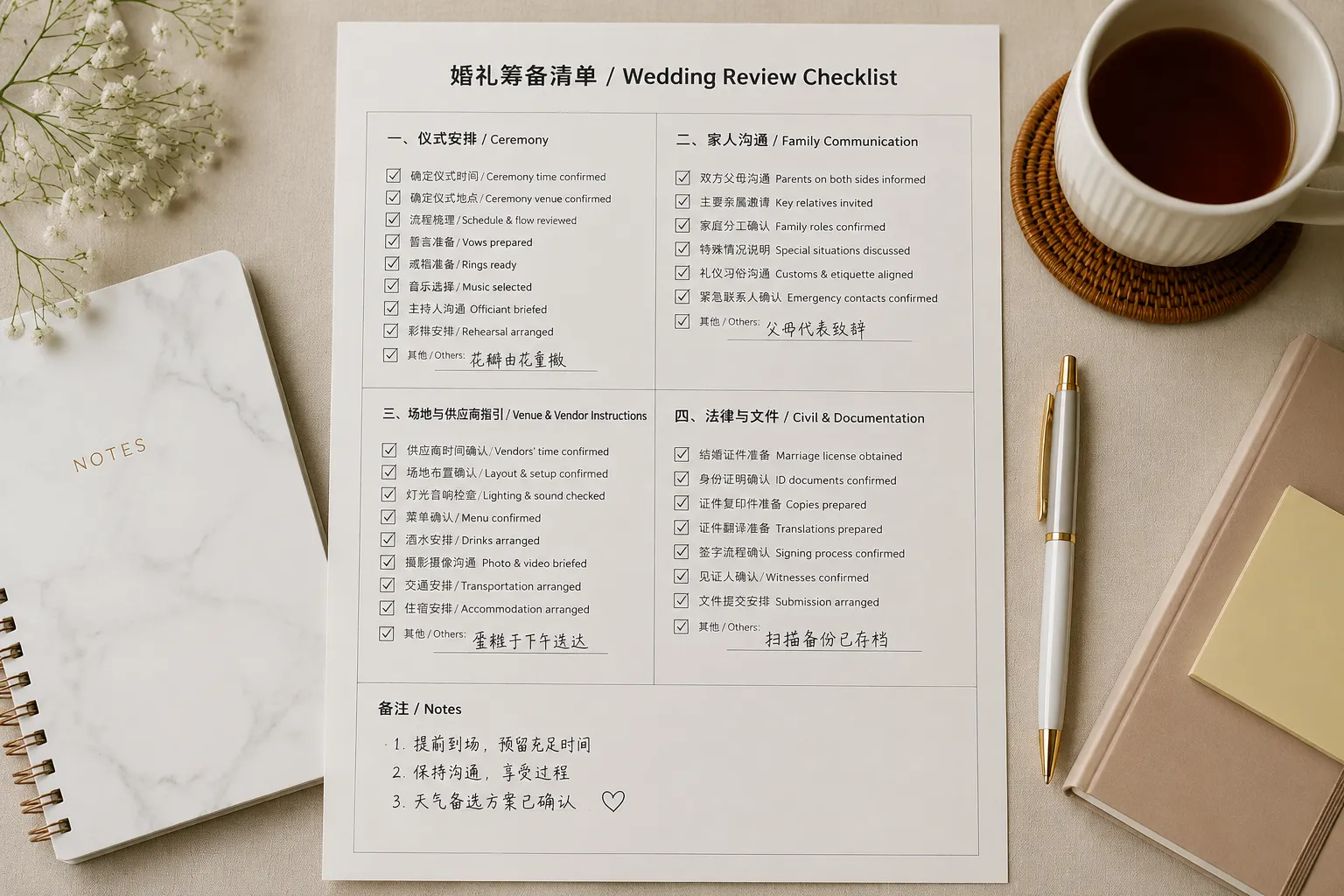
Names and family roles
- Names match the couple's preferred spelling, accents, and capitalization.
- Parents, sponsors, padrinos, madrinas, readers, witnesses, and other roles are identified correctly.
- Family relationships have not been inferred from unclear wording.
- Pronunciation notes are available for names being spoken.
Ceremony wording
- Ceremony stages appear in the planned order.
- Liturgical wording is separated from program explanations.
- Readings, vows, prayers, responses, and blessings have the correct status.
- Uncertain ceremonial phrases have been raised with the parish.
- The bilingual version does not suggest that one local format applies everywhere.
Printed program
- Headings follow the chosen language order.
- Explanations are written for guests rather than presented as ceremonial text.
- Page breaks do not separate a heading from its explanation.
- Repeated terms match the style sheet.
- Program instructions match the ceremony plan.
Family and venue communication
- Dates, times, locations, and responsibilities are clear.
- Preferences are distinguished from firm arrangements.
- Family expectations are labeled as family decisions, not universal requirements.
- Arrival, setup, photography, music, seating, and vendor instructions are kept separate from ceremony wording.
- The venue has confirmed the operational details that people must follow.
Civil paperwork
- Each document is identified by purpose.
- Questions about translation, submission, or handling go to the relevant civil registry office or authority.
- No family-created wording is presented as a complete document list.
- Names, dates, copies, and document references are checked against the source records.
- Paperwork status is recorded separately from the wedding program review.
Scope of the Checklist
Catholic materials can help organize matrimony terminology and ceremony stages. Translation guidance can support assigning reviewers, separating translation from interpreting, and maintaining consistent terminology. Research on Spanish-English Catholic services can help explain differences between ritual language and surrounding communication.
These references do not establish Mexican wedding customs, one family's expectations, a universal Spanish-English wedding script, a parish's current procedures, venue policy, civil registry handling, or acceptance of translated documents. Those questions belong with the relevant parish, venue, civil registry office, or local authority.
A bilingual wedding style sheet is a coordination tool. It helps each person review the wording connected to their responsibility, then directs unresolved questions to the person or institution responsible for that setting.