Bilingual Catholic Wedding Program Template and Review Checklist
Preparing an English-Spanish wedding program involves two separate tasks: explaining the ceremony for guests and checking the wording against the sequence confirmed by the parish. Start with the parish’s information, then shape the program around that sequence.
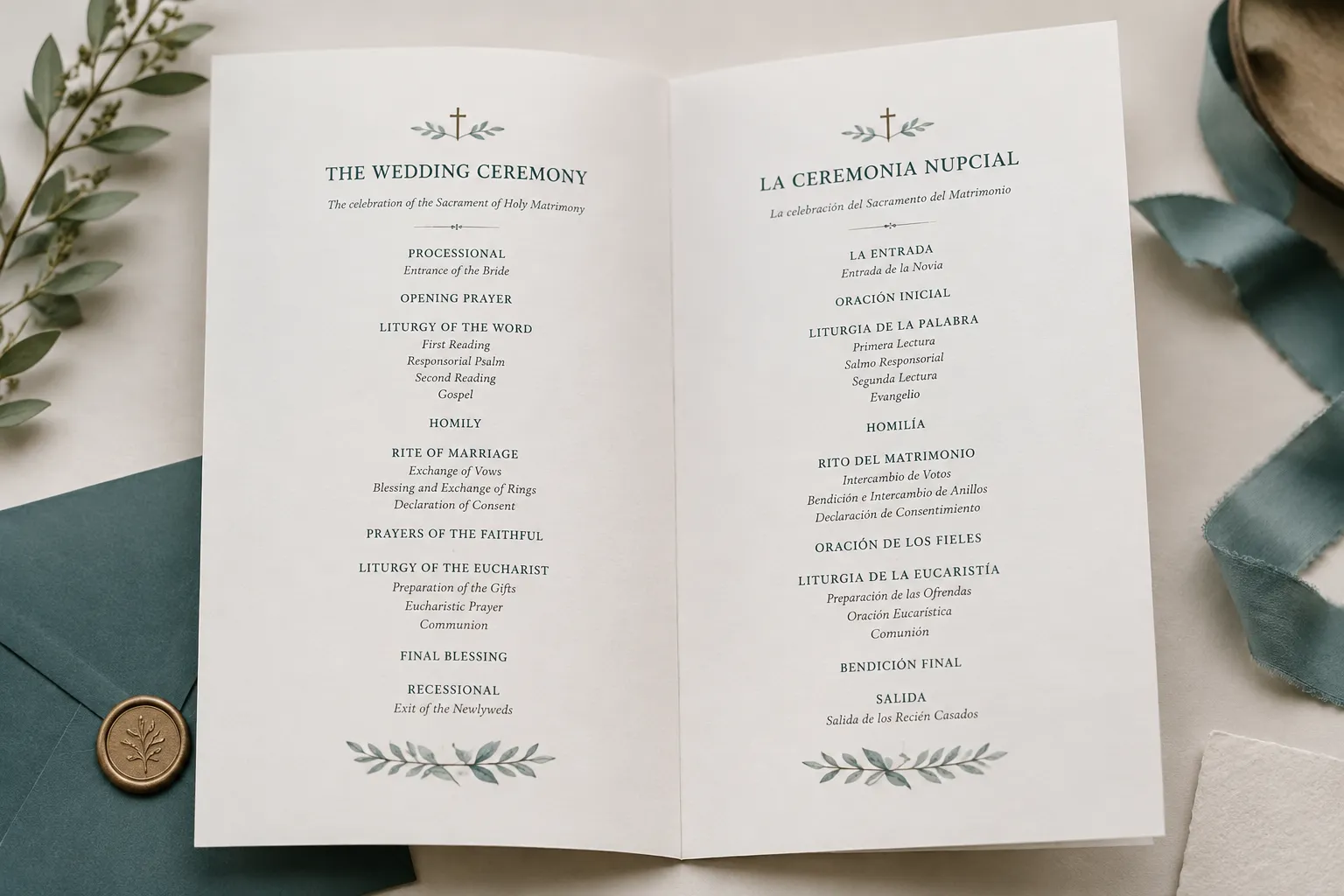
A guest-facing program can summarize ceremony parts, identify participants, provide bilingual wording, and help guests follow responses or music. It does not replace the parish’s liturgical text, determine church procedure, or provide civil registration instructions.
- Ask the parish about the ceremony form, sequence, readings, responses, music, and language choices.
- Build the program from those details.
- Compare the English and Spanish wording for meaning and readability.
- Check names, roles, order, page breaks, and print quality.
- Send the final proof to the parish before printing.
What the Program Can Include
The contents vary by parish, ceremony form, family preference, and whether the wedding is celebrated within Mass. A practical bilingual Catholic wedding program may include:
- The couple’s names, wedding date, and church or parish name
- A short welcome in English and Spanish
- Names and roles of the presider, deacon, readers, musicians, and other participants
- The main ceremony sequence
- Readings, references, or brief descriptions
- The responsorial psalm and Gospel acclamation
- Questions before consent and the exchange of consent
- The blessing and exchange of rings
- Prayers of the faithful
- The nuptial blessing
- The Liturgy of the Eucharist, when included
- Short notes about when guests stand, sit, respond, or sing
Do not assume every item belongs in every program. The parish may use another ceremony form, omit some sections from a guest handout, or request particular wording.
Keep the distinction clear: the parish-confirmed ceremony order guides the celebration, while the printed program makes that order easier for guests to follow.
Simple English-Spanish Program Template
Use the following as a planning structure, not as a final liturgical script. Confirm ceremony-specific wording with the parish before printing.
Cover
Wedding of
[Name] and [Name]
Boda de
[Name] y [Name]
[Date]
[Church or parish name]
[City and state]
English may appear first, or Spanish may appear first. Consider which language most guests read comfortably, which language is used first during the spoken ceremony, and whether older relatives need larger type. Choose the order early because it affects every page.
Welcome
Welcome to the celebration of the marriage of [Name] and [Name].
Bienvenidos a la celebración del matrimonio de [Name] y [Name].
Keep the welcome brief. It can acknowledge both language groups without competing with the ceremony information.
Ceremony Sequence
| English | Spanish |
|---|---|
| Entrance Rite | Ritos iniciales |
| Liturgy of the Word | Liturgia de la Palabra |
| Celebration of Matrimony | Celebración del Matrimonio |
| Liturgy of the Eucharist, when included | Liturgia de la Eucaristía, cuando corresponda |
| Concluding Rite | Rito de conclusión |
Under each heading, the program may list relevant parts such as readings, the Gospel, questions before consent, the exchange of consent, rings, prayers of the faithful, the nuptial blessing, Communion, the final blessing, and the recessional.
This terminology describes a broad Catholic structure. It is not a universal printed order for every parish. Compare the draft with the sequence supplied by the parish or presider.
Readings and Participants
First Reading
[Book, chapter, and verses]
Reader: [Name]
Responsorial Psalm
[Psalm title or response]
Cantor: [Name]
Gospel
[Book, chapter, and verses]
Presider or deacon: [Name]
Follow the parish’s preferred citation style and reading titles. Do not choose readings solely because they appear in a sample program. Confirm which readings are available for this celebration.
Participation Note
Please join in the responses and singing as indicated.
Participen en las respuestas y los cantos cuando se indique.
The parish may prefer different wording or may not want participation instructions included. Ask before adding them.
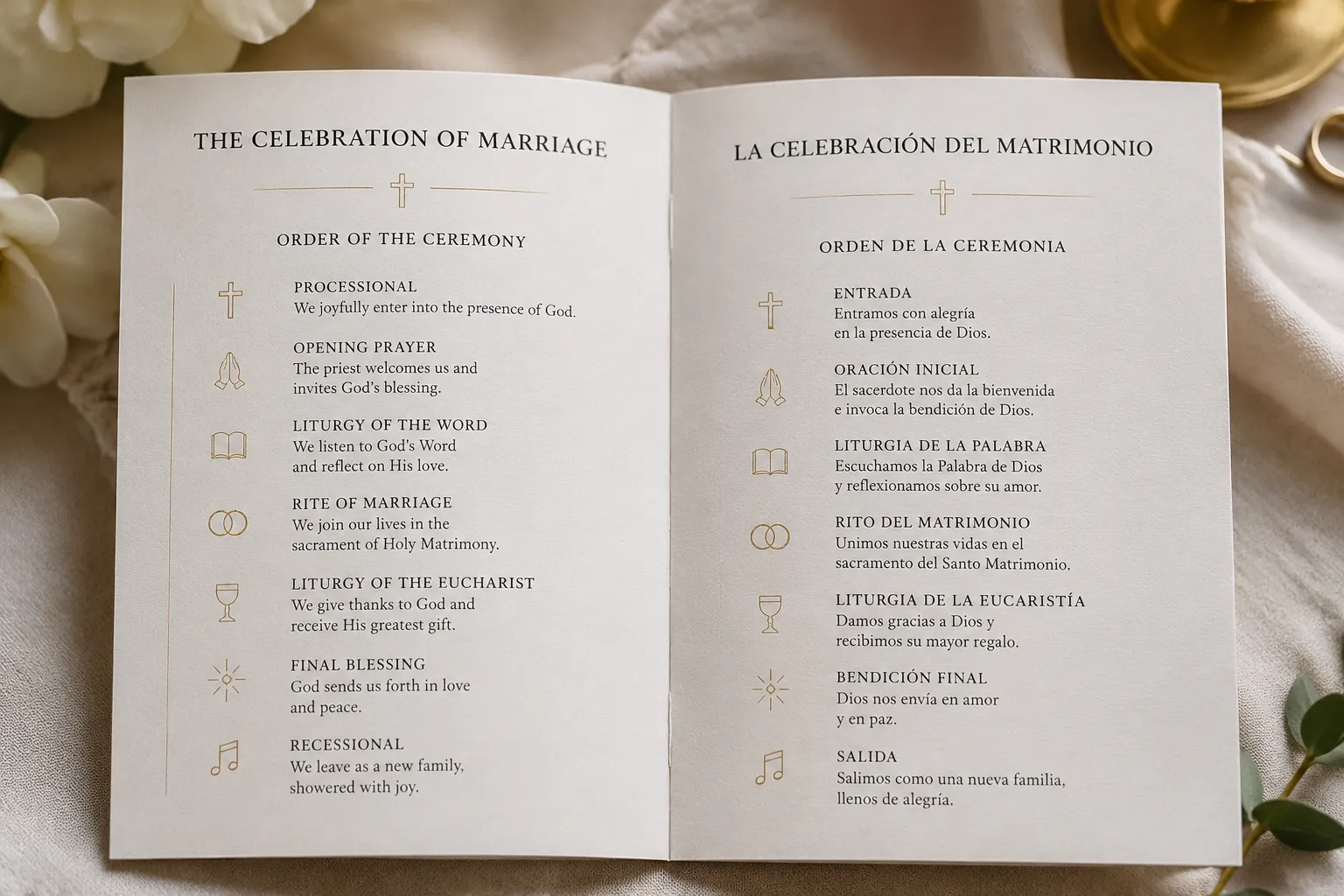
Review the Catholic Ceremony Sequence
Confirm the Ceremony Form
Ask whether the wedding will be celebrated within Mass, outside Mass, or according to another form or local pastoral arrangement. A wedding program built around Mass can confuse guests when the celebration follows a different form.
If the celebration involves different religious circumstances or a separate civil ceremony, ask the parish and the relevant local authority which information belongs in the program. Keep guest communication separate from civil registration instructions.
Check the Major Parts
Compare the draft with the sequence confirmed by the parish. Check the placement of:
- Entrance and opening prayers
- Readings and the Gospel
- Questions before consent
- Exchange of consent
- Exchange and blessing of rings
- Prayers of the faithful
- Eucharistic sections, when included
- Nuptial blessing
- Final blessing, dismissal, and recessional
A published Catholic ceremony reference can help explain terminology and broad structure. It does not show that every parish uses the same sequence or wording.
Ask About Optional Elements
Discuss the following with the priest or parish contact:
- Reading selections
- Music and hymns
- Prayers of the faithful
- Processional and recessional details
- Language used for readings, prayers, and responses
- Cultural or family elements
- Whether the program should reproduce, summarize, or omit particular texts
An element appearing in another wedding program is a planning example, not evidence that it belongs in yours.
Review the English-Spanish Wording
A bilingual wedding program needs more than word-for-word substitution. Each language should communicate the same practical meaning and remain natural for the guests who read it.
Compare Meaning Before Appearance
Review each English-Spanish pair line by line. Check:
- Names, accents, and titles
- Religious terms and ceremony-part names
- Scripture references
- Singular and plural forms
- Formal or familiar forms of address
- Instructions for standing, sitting, responding, or singing
- Punctuation and capitalization
- Gendered forms where relevant
A literal translation can sound awkward or shift the emphasis of a sentence. Have fluent readers review both languages, then confirm ceremony-specific wording with the parish.
Choose a Consistent Layout
- English followed by Spanish: useful for short headings, responses, and instructions.
- Spanish followed by English: places Spanish first when that better serves the congregation.
- Two columns: lets guests compare both languages while staying in one section.
- Separate language sections: reduces visual crowding but may require more page turning.
- Alternating sections: assigns some readings, prayers, or explanations to one language and others to the second.
There is no single bilingual format for every congregation. The spoken ceremony may alternate languages differently from the printed program, so treat the layout as a guest-experience decision.
Manage Length and Readability
Repeating every line in two languages affects page count, font size, folding, binding, printing cost, and how quickly guests find the current section.
For example, the program might list reading references and participants without printing every reading in full. Whether full texts are suitable depends on the parish, the selected materials, copyright considerations, and the couple’s goals. Do not reduce the type until it becomes difficult to read.
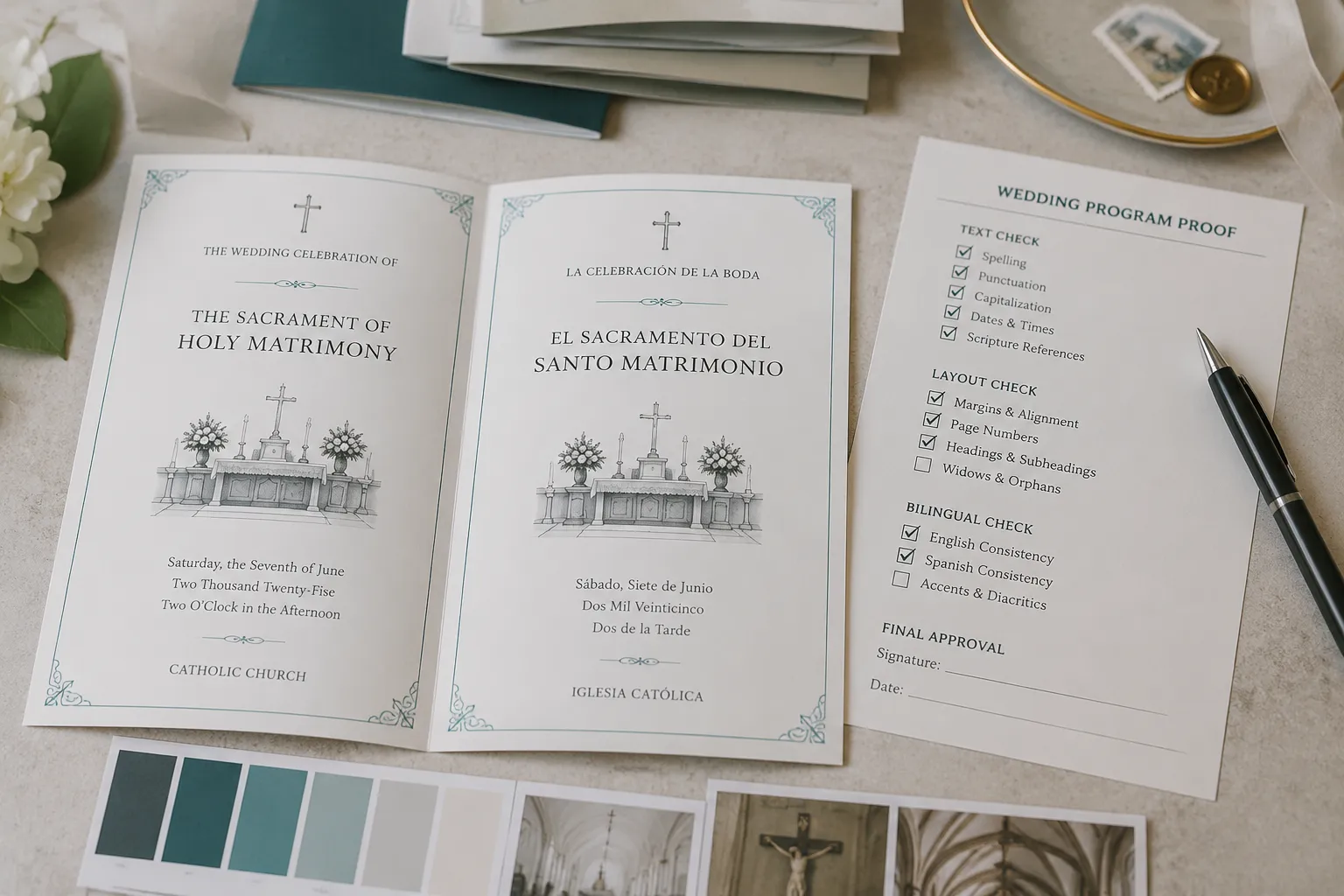
Catholic Wedding Program Review Checklist
Parish and Ceremony Details
- Confirm the ceremony form with the parish.
- Compare the draft with the sequence supplied by the parish.
- Check the date, time, church name, and location.
- Verify the presider’s name and title.
- Confirm readers, musicians, witnesses, and other participant names.
- Ask about wording or formatting preferences.
- Confirm the readings, prayers, responses, and music being used.
- Ask whether cultural or family elements may be listed.
- Ask whether the parish wants a final proof before printing.
English-Spanish Wording
- Check names, accents, and titles in both languages.
- Compare translated headings and instructions for meaning.
- Verify Scripture references in both versions.
- Check congregational responses and participation notes.
- Use consistent terms for marriage, matrimony, blessing, reading, and prayer.
- Have fluent readers review the wording.
- Confirm ceremony-specific language with the parish.
- Remove wording that sounds uncertain or machine-generated.
Layout and Proofing
- Decide which language appears first.
- Keep the language order consistent.
- Make headings easy to find.
- Leave enough space between English and Spanish text.
- Check that repeated text does not create cramped pages.
- Review font size, contrast, margins, and page breaks.
- Make sure names do not split awkwardly across lines.
- Inspect a physical proof before ordering the full quantity.
Questions to Ask Before Printing
- Does this program reflect the ceremony sequence planned for our wedding?
- Are the ceremony-part names and order correct?
- Are the readings, prayers, responses, and music listed accurately?
- Are the English and Spanish versions suitable for this celebration?
- Should any text be shortened, omitted, or changed?
- May cultural, family, or symbolic elements be included?
- Does the parish have a preferred format or final review process?
- Are there venue instructions that should be communicated separately?
For civil paperwork, travel, consular matters, or registration timing, ask the applicable civil registry office, consulate, venue, or local authority. The wedding program is a guest communication tool and does not replace those instructions.
Final Review
A useful bilingual Catholic wedding program is accurate, readable, and clear about its role. Build it from the ceremony sequence confirmed by the parish, then review the English-Spanish wording and layout as separate guest-experience tasks.
The available material supports broad Catholic terminology, ceremony structure, multilingual planning considerations, and questions to confirm. It does not establish one universal English-Spanish template, exact translation, parish policy, Mexican Catholic custom, or civil registry process. Resolve those details with the parish and, where relevant, the appropriate civil registry office, consulate, venue, or local authority.
Sources
- Marriage: Sacrament of Matrimony
- Order of Celebrating Matrimony
- Marriage as sacrament and covenant: A new model for pre-marriage education based upon the rite of marriage
- The Ordo Celebrandi Matrimonium 1991 as a Case Study of the Creative Exchange between Liturgical Traditions and Theological Developments
- Language alternation and choice in a formal register: Spanish and English in bilingual Catholic services
- The Precedent for Vernacular and Multilingual Liturgies in the Catholic Church in Latin America
- “I Thought It Was Beautiful; I Just Wish I Could Understand It”: The Awkward Dance of Multilingual Worship